In this interview, Romano Albesiano, appointed as Technical Director of HRC discusses how Sprint Filter’s technology integrates into the RC213V project, the importance of filtration stability, and why airflow management is becoming an increasingly crucial frontier in top-level racing.

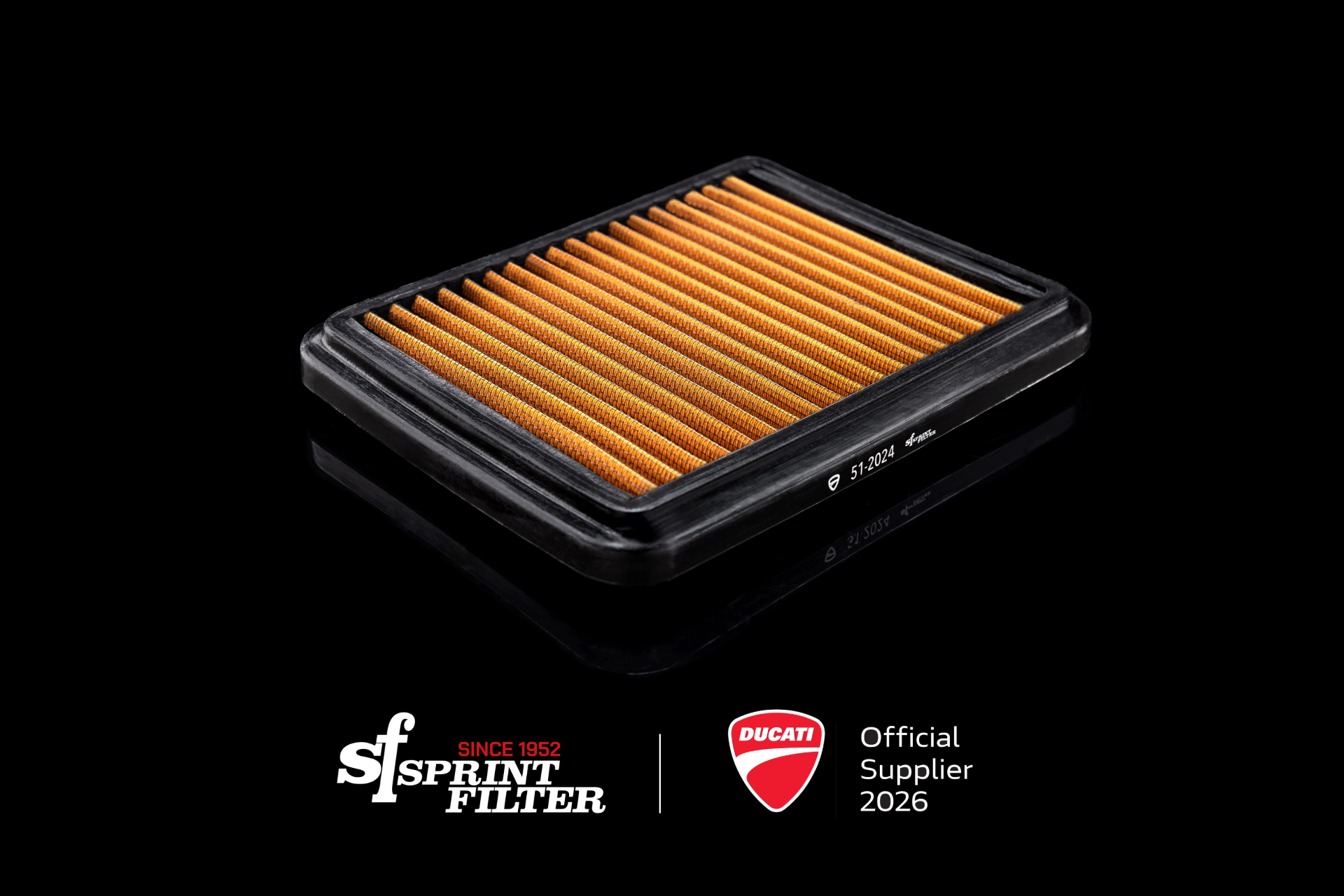
Sprint Filter: Since 2017 Honda HRC has been working with Sprint Filter in MotoGP (and over time also in Moto3, SBK, and the Asia Talent Cup). In a category where every detail makes the difference, how crucial is it to have a specialized partner on highly sensitive components such as the air filter, especially in terms of co-development and speed of iteration?
Romano Albesiano: When I arrived at HRC, they already had a strong relationship with Sprint Filter. Having partners who are specialists in certain areas is always a positive and we have been able to work closely with Sprint Filter to fulfill all our needs. With everything so close in MotoGP currently, you need to look at every area to try and find some advantage – with better breathing performance we can help to improve the engine performance.
SF: The RC213V features a highly advanced aero package (wings, ducts, air channels). To what extent do Sprint Filter’s polyester fabrics—characterized by very low pressure drop and reduced internal turbulence—affect the integration between external aerodynamics and the engine’s “breathing”? Is this already taken into account in CFD simulations, particularly in the design of the airbox, dynamic intake, and intake ducts?
RA: Air filter shape and the filtering characteristic are very important to ensure correct aerodynamics of the intake flow.
SF: Today the bike must be seen as a single integrated system. In what way does an “apparently simple” air filter actually become a design constraint/element that impacts airbox volume, positioning, vibro-acoustics, and overall packaging?
RA: With the aerodynamics and the general boundaries of MotoGP rules, the ‘packaging’ is very important as you constantly balance a number of factors. There are multiple reasons why you would want a wider bike, but an equal or even greater number of reasons as to why you would want a slim bike.
SF: Unlike oiled filters, which improve filtering capacity only after a “dust cake” builds up—at the cost of reduced airflow—Sprint Filter units maintain consistent efficiency from the start to the end of a race. How relevant is this consistency when simulating fuel consumption and ensuring ECU mapping reliability in MotoGP, especially during long stints and under variable environmental conditions?
RA: As I have outlined, consistency is very important not just for our calculations but also for the performance of the rider over the course of the race. Consistency helps them to perform and helps us to create accurate models to prepare for the race, without this you cannot properly prepare as you cannot properly predict what will happen.